

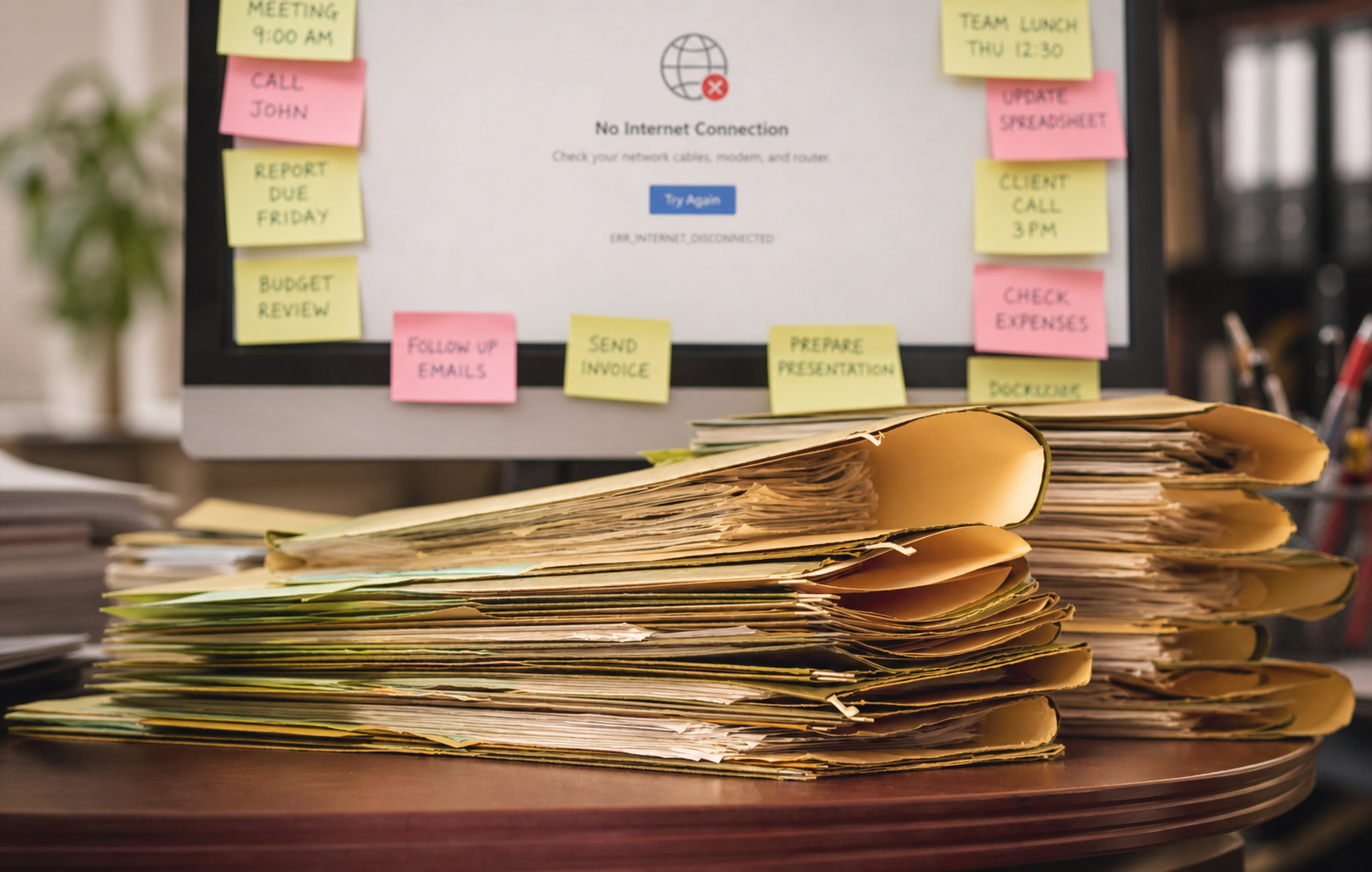
Reliable internet now underpins how businesses answer customers, process payments, access cloud systems, collaborate with staff and communicate with suppliers. When that connection fails, the business slows down.
One of the first questions we ask a new client is simple: what happens in your business the moment the internet drops? The answers tell us more than any speed test. Missed emails. Delayed approvals. Frustrated customers. Staff locked out of a shared drive. A 2026 Business Council of Papua New Guinea (BCPNG) study found that 93% of surveyed businesses rely on the internet, which matches what we see on the ground. Most businesses are connected, though a smaller share are putting that connection to work to create value.
We’ve seen offices stop working entirely because their only internet connection failed, with no backup plan in place. That points to an operational failure, running deeper than the technology itself.
Being offline rarely shows up as one big loss. It shows up as slower response times, staff falling back on phone calls and paperwork, and customers who move on because nobody replied fast enough. The BCPNG study found that connectivity suitable for a small business is unaffordable for over 80% of PNG earners once backup connections and power generation are added to the bill. In practical terms, staying offline means paying in time, labour and missed opportunity. Those costs rarely show up on a balance sheet, but they always show up in growth.
We regularly see branches working from different versions of the same spreadsheet, and managers approving invoices over WhatsApp because there’s no proper workflow behind them.
We’ve seen businesses with modest budgets outperform much larger organisations, because they fixed the right operational problems first. Connectivity was one of them. We’ve noticed the gap between the two groups usually comes down to sequencing, not budget. 80% of BCPNG respondents said better internet access would help them grow or run their business more effectively, which lines up with what we hear directly from clients. Businesses that delay usually pay for it twice: once in lost opportunity, and again when they have to catch up fast, with less time to train staff or choose the right tools.
We start digital projects by understanding how the business operates: where staff lose time, where customers wait too long, and where a single outage does the most damage. That’s usually communication, payments, record-keeping or customer enquiries. From there, we treat connectivity as part of business continuity: backup options, power reliability and staff workarounds get assessed before a disruption happens, not after.
The internet, now more than ever, is basic business infrastructure. The advantage comes from what a business does with that connection.
The right investment is the one that solves a business problem. For most businesses in PNG, that starts with a connection you can actually rely on.
Want to know where your business is losing time to connectivity gaps? Get in touch with our team for a practical, tailored assessment.


Hello! Thank you for contacting us. We always aim to help our clients and customers. kindly review and select your request type;